
The Forum attracted 70 delegations from innovation centers and large corporations, 5 government delegations (Kuwait, Japan, Oman, Qatar, China), 4 delegations from international ministries and agencies (Cambodia, Malaysia, Laos, Australia), 8 delegations from international localities, 7 delegations from major international organizations such as the United Nations (UN), International Monetary Fund (IMF), and Asian Development Bank (ADB), and representatives from 10 global Centers for the Fourth Industrial Revolution (C4IR).
This diversity in participation underscores the Forum’s credibility and reputation, establishing a comprehensive and high-level strategic dialogue platform that fosters multinational cooperation in green economy, digital transformation, and innovation. Notably, Mr. Stephan Mergenthaler – Executive Director of the World Economic Forum (WEF) – together with leaders of several WEF departments and centers, attended in person. Their deep engagement demonstrates WEF’s strong interest and commitment to advancing its strategic partnership with Viet Nam in general and Ho Chi Minh City in particular in the time ahead.
At the Forum, Prime Minister Phạm Minh Chính delivered a strong commitment to prioritizing green–digital dual transformation, positioning Viet Nam not only as a promising market but also as a reliable partner and strategic destination for global sustainable development and technology initiatives. The event recorded an unprecedented attendance of over 1,800 delegates, including 500 CEOs, leaders of multinational organizations, and policymakers from over 30 countries, reaffirming Viet Nam’s growing importance within global value chains and in shaping global solutions.
During the special dialogue program “60 Minutes with the Prime Minister of Viet Nam”, Prime Minister Phạm Minh Chính exchanged directly with Mr. Stephan Mergenthaler to clarify Viet Nam’s new development orientation amid profound global economic transformation.
The Prime Minister emphasized that Viet Nam’s development path is built on independence, self-reliance, peace, cooperation, and future-oriented thinking. After decades of war, blockade, and sanctions, Viet Nam chose to set aside the past, find common ground in differences, and focus on socio-economic development.
From a poor agricultural country, Viet Nam has advanced industrialization, reaching an economic scale of around USD 510 billion and per-capita income exceeding USD 5,000. In the coming period, science–technology, innovation, and the twin engines of digital and green transformation will be the foundation for Viet Nam to realize its goal of becoming a developed, high-income nation by 2045.
Presenting the new development vision, Prime Minister Pham Minh Chính identified green transition and digital transition as the two pillars of Viet Nam’s next growth model. Viet Nam will prioritize completing institutional frameworks for emerging sectors such as renewable energy, data, green finance, and carbon markets; developing strategic infrastructure including clean energy, smart grids, high-quality telecommunications and data systems, and digital governance platforms; mobilizing international resources in finance, technology, expertise, and high-quality human capital training.
On this foundation, Viet Nam maintains three consistent development principles: (i) Putting people and businesses at the center of all policies; (ii) Upholding an external policy of peace, cooperation, and responsibility; (iii) Considering innovation, science–technology, and the collective strength of the people as key drivers.
Regionally, the Prime Minister affirmed that Viet Nam aligns its development future with ASEAN – one of the world’s fastest-growing regions. Viet Nam proposes: Strengthening interregional infrastructure connectivity in transport, logistics, and energy; Building shared digital infrastructure and data exchange frameworks; Coordinating to implement the ASEAN Power Grid Initiative to enhance energy security; Promoting intra-regional trade, investment, and innovation.
The Prime Minister also emphasized the central role of dialogue amid rising geopolitical uncertainties. Viet Nam pursues an independent, balanced, multilateral, and diversified foreign policy, and stands ready to serve as a bridge to foster dialogue, narrow differences, build trust, and contribute to regional and global peace and stability. Viet Nam also reaffirmed its readiness to coordinate with WEF and international partners to promote new cooperation initiatives.
National Strategy: Delivering the Dual Transformation through Five Breakthrough Solutions
Regarding global commitments, Viet Nam reaffirmed its target of achieving net-zero emissions by 2050 and is actively implementing the National Green Growth Strategy and the Just Energy Transition Program (JETP) by mobilizing international finance for renewable energy and low-carbon infrastructure. Simultaneously, Viet Nam is accelerating digital transformation, aiming to become a regional leader in digital government, digital economy, and digital society.
This development strategy is operationalized through five breakthrough solutions:
1. Institutional reform as the leading step
Improve legal and policy frameworks for emerging sectors such as renewable energy, green finance, data economy, and innovation.
2. Green and digital infrastructure as strategic investment priorities
Strongly invest in green infrastructure and digital infrastructure projects.
3. High-quality human capital development
Train a highly skilled workforce capable of mastering advanced technologies such as AI, semiconductors, and Industry 4.0 technologies.
4. Promoting the role of public–private partnerships (PPP)
PPP is a key mechanism to unlock all societal resources, mobilizing both domestic capacities and international capital into Viet Nam.
5. Smart governance to optimize resources
Efficiently manage national resources—natural, financial, and human—through analytical, forecasting, and smart decision-making tools, thereby improving investment efficiency, increasing productivity, and building a foundation for long-term sustainable development.
Prime Minister Phạm Minh Chính affirmed that the domestic and international business community is the decisive force behind the success of the country’s dual transformation. Viet Nam is committed to maintaining a transparent, stable institutional environment; building synchronized infrastructure systems; and improving human-capital training to support sustainable business development and deeper integration into global value chains. He underscored three essential conditions for enabling businesses: transparent, streamlined, and stable institutional environment; high-quality strategic infrastructure that reduces input costs; well-trained, appropriately skilled workforce that supports business growth. As businesses grow, their managerial thinking and capabilities must also advance.
At the Forum, major organizations and corporations announced concrete investment and cooperation commitments:
● World Economic Forum (WEF):
In addition to cooperation areas related to smart manufacturing and responsible industrial transformation for Ho Chi Minh City in particular and Viet Nam in general, Mr. Stephan Mergenthaler, WEF Executive Director and Chief Technology Officer, also committed to expanding support programs for businesses and youth in Viet Nam and Ho Chi Minh City. These programs will focus on key themes such as net-zero, artificial intelligence (AI), and green finance.
● Global Government Technology Center (C4IR Berlin):
Mr. Manuel Kilian, Director of the Center, assessed that “Ho Chi Minh City’s reform momentum and digital transformation drive are truly distinctive.” On this basis, the Center will soon collaborate with Ho Chi Minh City on three major areas: developing a technology startup ecosystem; applying IoT in traffic management, data systems, and business operations; and piloting a digital government model aligned with international standards. In December, both sides are expected to finalize a detailed project portfolio to ensure rapid progress and clear results.
● MassRobotics:
Mr. Daniel Theobald – Co-founder of MassRobotics – noted that Ho Chi Minh City shares many similarities with Silicon Valley in its early stages and emphasized that the City “is moving very fast and in the right direction.” He expressed readiness to deploy robotics models in industrial production, smart agriculture, digital healthcare, and to support technology startups in overcoming the early-stage development gap and expanding access to global markets.
● Foxconn Industrial Internet (Fii):
A strategic link in smart manufacturing. Mr. Brand Cheng, Chairman of Foxconn Industrial Internet, affirmed that expanding investment in Viet Nam stems from a proactive and consistent policy environment. He emphasized that Viet Nam has become an important link in the global supply chain.
● Ant International:
Mr. Yang Peng, Executive Director of Ant International, stated that Ho Chi Minh City possesses three “golden advantages” to break through and become a next-generation International Financial Centre: (i) Digital readiness; (ii) a strategic gateway position at the heart of Southeast Asia – the world’s fastest-growing region; and (iii) a dynamic SME ecosystem.
Currently, Ant International has over 200 personnel in Viet Nam, most of whom are high-quality professionals, with 90% being engineers in software, artificial intelligence, cybersecurity, and data science. The company plans to continue investing and expanding to build Ho Chi Minh City into a technology and operations hub, serving as a launchpad for the corporation to provide services to global markets.
Ant International also committed to accompanying the Government of Viet Nam and Ho Chi Minh City through concrete actions: (i) Providing information to support policy formulation; (ii) Offering advanced technological solutions to enhance competitiveness and promote the globalization of Vietnamese SMEs; (iii) Developing next-generation talent; (iv) Promoting domestic innovation; (v) Bringing globally proven core technologies to Ho Chi Minh City, including the development of intelligent data centers serving SMEs.
● Global On-chain Economy Alliance (GOE Alliance) and Ho Chi Minh City International Financial Centre (IFC HCM):
GOE Alliance – with the participation of Viettel Digital, Dragon Capital, Tether, Ava Labs, Sky Mavis, Republic, and On-chain Academy – committed to three key areas: (i) Developing high-quality talent and high-quality projects; (ii) Connecting global on-chain infrastructure with Ho Chi Minh City as the hub; and (iii) Contributing substantial economic value to the Ho Chi Minh City International Financial Centre (IFC HCM).
● Amazon Global Selling:
Recognizes Viet Nam as a key growth driver for Southeast Asia’s digital commerce; officially launched Amazon Global Logistics (AGL) operations in Viet Nam, enabling goods to be shipped directly from Viet Nam to Amazon FBA warehouses in the United States.
● TikTok:
Proposed supporting the establishment of three legal entities in Ho Chi Minh City that would provide e-commerce, digital payment, and digital logistics services to serve more than 40 million Vietnamese customers.
Aspirations of a Mega-City: Ho Chi Minh City’s Leading Role
As the host of the first Autumn Economic Forum, Ho Chi Minh City is demonstrating its aspiration to become an international mega-city and a regional hub for economy, finance, science, and technology. Mr. Trần Lưu Quang, Secretary of the Ho Chi Minh City Party Committee, affirmed the City’s development vision based on five strategic pillars: (i) High-tech industry; (ii) Logistics and free trade; (iii) Ho Chi Minh City International Financial Centre (IFC HCM); (iv) Tourism and cultural industries; (v) International-standard education, healthcare, and science–technology.
With its GRDP accounting for approximately 23.5% of Viet Nam’s national GDP and per-capita GRDP approaching USD 9,000 (2025), Ho Chi Minh City continues to serve as the nation’s economic locomotive and is committed to ensuring the best possible conditions for investors.
The Autumn Economic Forum 2025 reaffirms Viet Nam’s readiness to work alongside businesses, experts, and investors under the principle of “A facilitating State – pioneering enterprises – public–private partnership – and shared benefits for the people and businesses.”
Prime Minister Phạm Minh Chính reiterated Viet Nam’s consistent foreign policy approach: “We remain steadfast in the view that all disputes and differences must be resolved through dialogue and peaceful means. On that basis, Viet Nam is ready to work with the World Economic Forum and partners to promote dialogue, reduce tensions, and contribute to peace, stability, and development worldwide.”
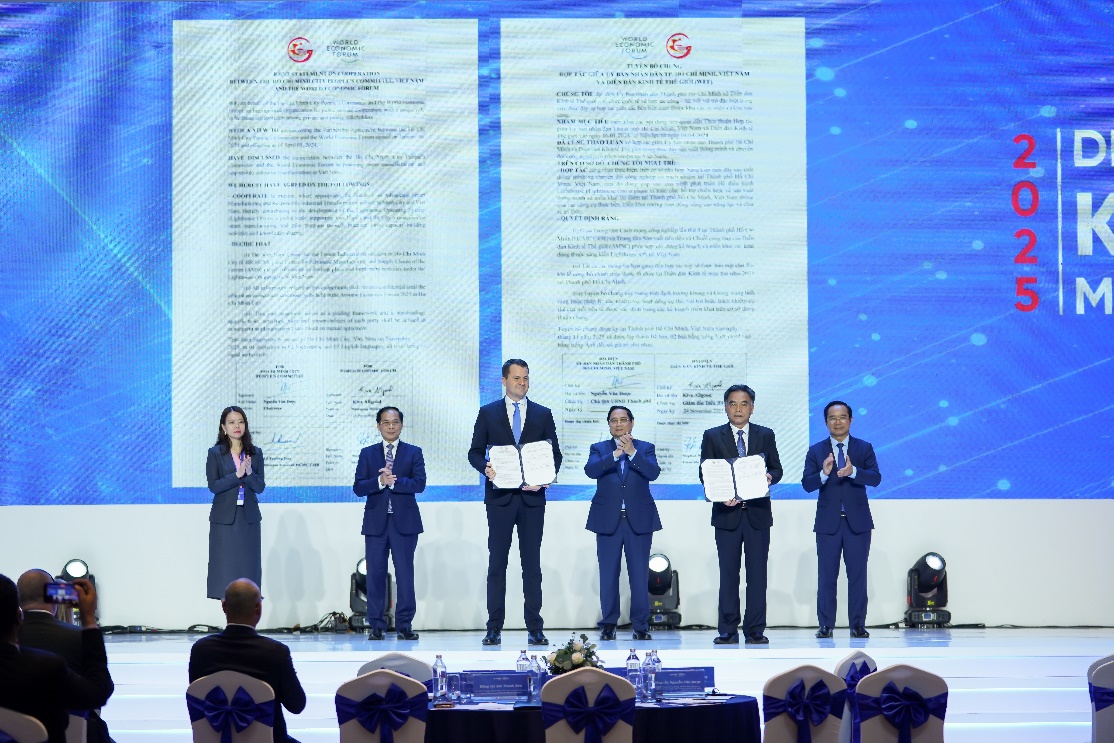
The Joint Declaration between Ho Chi Minh City and WEF on smart manufacturing and responsible industrial transformation marks an important milestone, underscoring the City’s and Viet Nam’s role as “co-creators” in global initiatives led by WEF. This reflects the new position of Viet Nam and Ho Chi Minh City within international cooperation networks. Through this milestone, Ho Chi Minh City joins the global innovation and manufacturing network as an active contributor, helping shape advanced industrial models that support the country’s green and sustainable development in the new era.
With 14 cooperation agreements signed and one alliance announced at the Forum—across green and digital sectors such as energy, logistics, artificial intelligence, and finance—alongside a series of sideline meetings and numerous bilateral and multilateral engagements, the Forum underscores its essential role in translating ideas into real-world solutions. Through the Forum, the bridge between enterprises and government, and between domestic and international resources, is strengthened—creating opportunities for all sides to exchange, collaborate, and jointly pursue integrated development solutions that connect the green economy with the digital economy.
The Forum also reaffirmed the strong commitment of Viet Nam and Ho Chi Minh City to offering the best possible support and a highly conducive environment for businesses, investors, scientists, and international organizations in applying science–technology and fostering innovation.
This demonstrates the City’s vision and ambition to become a leading innovation hub in Southeast Asia—a green, smart, and livable mega-city making meaningful contributions to national and regional development. The Forum represents a major milestone in Ho Chi Minh City’s journey to become a premier destination within the innovation ecosystem—a place where new ideas are nurtured, expanded, and transformed into forces that shape development in the era of the digital economy.